Reviews
Strategic Tic-Tac-Toe takes a familiar game and adds a layer of strategy that keeps you engaged. The rule that your opponent's move decides your next board forces constant adaptation. It is easy to pick up but offers enough depth for repeated play. The clean interface and quick rounds make it perfect for short sessions. A solid choice for puzzle fans looking for a new challenge.
About this game
Game Introduction
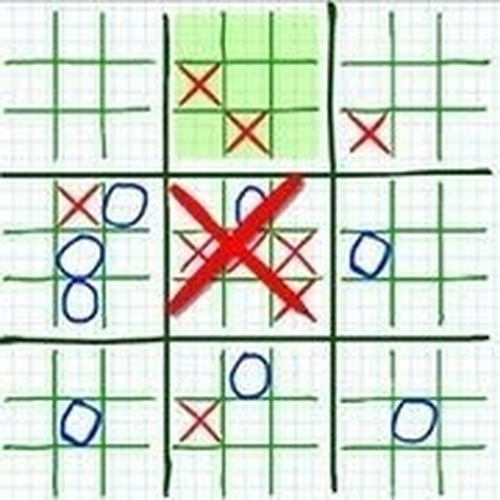
Strategic Tic-Tac-Toe transforms the traditional game into a more complex and engaging experience. Instead of playing on a single board, you compete on nine mini boards arranged in a larger grid. The goal is to win three mini boards in a row, either horizontally, vertically, or diagonally. What makes this game truly unique is that you cannot choose which mini board to play on next; your opponent's previous move determines it. This mechanic forces you to think ahead and adapt your strategy, making every game a fresh challenge. Perfect for players of all ages, it combines simple rules with deep strategic possibilities.
How to Play
To play Strategic Tic-Tac-Toe, start by making a move on any of the nine mini boards. After your move, your opponent's next play must be on the mini board that corresponds to the position of your last move. For example, if you place your mark in the top-left corner of a mini board, your opponent must play on the top-left mini board. Continue alternating turns, aiming to win three mini boards in a row. The game ends when a player achieves this, or if all moves are exhausted. It is easy to learn but offers endless strategic depth.
Game Features
Game features include strategic gameplay that challenges your planning skills. It is family-friendly and suitable for all ages. The game is easy to learn with simple rules. Each match is unique due to the board selection mechanic. It offers a fresh take on a classic puzzle.
Tips for Success
To succeed in Strategic Tic-Tac-Toe, focus on controlling the center of the overall grid, as it often provides more options. Think several moves ahead, considering how your move will force your opponent's placement. Try to set up multiple threats simultaneously to make it harder for your opponent to block. Practice regularly to improve your strategic thinking and adaptability.
Compatibility
Play on Any Device | Chrome / Safari / Edge Recommended
Advertisement
Faq
Is this game suitable for children?
Yes, the game is family-friendly and suitable for all ages. Its simple rules make it easy for children to learn, while the strategic depth keeps it engaging for adults. It is a great way to introduce young players to logical thinking and planning.
Can I play this game offline?
The game is described as an online puzzle game, so it likely requires an internet connection to play against others or access features. However, some versions may offer offline practice modes. Check the specific platform for details.
How long does a typical game last?
A typical game of Strategic Tic-Tac-Toe can last anywhere from a few minutes to around 15 minutes, depending on the players' speed and strategy. The game ends when a player wins three mini boards in a row or all moves are exhausted.
Is there a time limit for each move?
The game description does not specify a time limit for moves. In many online versions, there may be an optional timer to keep games moving quickly, but it is not a core mechanic. Players can usually take their time to think.
Can I play against the computer?
The game is described as an online puzzle game, which suggests it may include a single-player mode against an AI opponent. Many games of this type offer both human and computer opponents to practice and improve skills.
What happens if all moves are exhausted without a winner?
If all moves are played and no player has won three mini boards in a row, the game ends in a draw. This is similar to a standard Tic-Tac-Toe tie. It can happen when both players play optimally or when the board becomes filled without a winner.